Home > Case Studies
Categories
Case Studies

Powering Robotics: Maxon & Mecademic’s Collaborative Success Story

MAXON

Powering robotics: Maxon & Mecademic's collaborative success story

01

Overview

Maxon, a pioneer in precision micromotors, and Mecademic, a leading provider of compact robotic systems, have formed a mutually beneficial partnership that fuels innovation in robotics. Maxon's motors have found their ideal match in Mecademic's robotic platforms, while Mecademic leverages Maxon's motors for comprehensive testing and validation. This collaboration has led to remarkable advancements and breakthroughs in robotics.

Case Study Video

Maxon red logo illuminated on a black background

Mecademic harnessing Maxon's motors

Mecademic industrial robots are the world’s most compact and precise, partly because of their motors. Mecademic uses Maxon's micromotors, which are known for their compact size, high power density, and exceptional control characteristics.

They seamlessly integrate into the Meca500, enabling unparalleled precision and reliability. The compactness and lightweight nature of Maxon's motors perfectly align with the Meca500's design, enhancing its maneuverability and versatility, creating a robust and agile robotic system capable of delivering precise and repeatable movements in diverse industrial automation applications.

02

Maxon relying on Mecademic for testing

In a reciprocal collaboration, Maxon relies on Mecademic’s Meca500 six-axis robotic arm to comprehensively test their motors. The robot’s precision and repeatability make it an ideal platform for testing and inspecting applications.

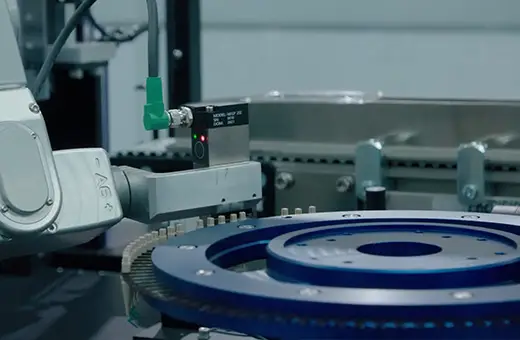
For Maxon, the Meca500 replaces the manual testing process in collector production, increasing efficiency and decreasing the possibility of human error. The Meca500 tests 280 printed circuit boards (PCBs) for Maxon’s miniature motors every 40 minutes. Its compact and lightweight design enables easy integration into the testing environment, effortlessly accommodating the small size of Maxon’s micromotors.

The Meca500’s versatility allows for customization and adaptation to meet specific testing requirements, ensuring a thorough evaluation of Maxon’s motors under varying loads, speeds, and control modes. Leveraging the Meca500’s high-speed operation, Maxon can thoroughly examine the dynamic behaviour and responsiveness of their motors.

03

Collaborative success

The collaborative relationship between Maxon and Mecademic has fostered innovation, resulting in the development of state-of-the-art robotics solutions. Maxon’s motors empower Mecademic’s robotic systems with precision, power, and reliability, while Mecademic’s robots provide Maxon with a robust testing platform to validate the performance of their motors.

The combination of Maxon’s expertise in motor technology and Mecademic’s proficiency in compact robotics has propelled both companies to new heights, delivering cutting-edge solutions that meet the demanding requirements of modern industrial automation.

Ready to find out how our products and solutions can increase your production throughput within the smallest possible footprint, without sacrificing precision or reach?

Want to learn more? 


Chat with our experts to get started on your application.

Categories
Case Studies

MATI Therapeutics Enhances Manufacturing Process with Meca500 Robot

MATI THERAPEUTICS

MATI Therapeutics enhances manufacturing process with Meca500 robot

01

Overview

Mati Therapeutics is a Texas-based company specialized in developing non-invasive drug delivery systems for ocular diseases. The company has been creating its own manufacturing equipment for over a decade, including incorporating Mecademic’s Meca500 – a six-axis robotic arm – into several machines. The Meca500 was chosen due to its small size, high precision, EtherCAT communication, integrated gripper, absence of a controller, affordability, and short lead time. After transitioning from a Contract Manufacturing Organization to building its own manufacturing facility, the Meca500 has proven to be the ideal choice for reducing space utilization and costs, increasing output and overall value for the company.

Case Study Video

CMO Setback​

Traditionally, Mati Therapeutic worked with a Contract Manufacturing Organization (CMO) to meet its production needs. However, significant pandemic-related delays in manufacturing meant the company could no longer rely on its CMO to meet project deadlines, forcing them to look elsewhere. But as other CMOs were also constrained at this time, Mati Therapeutics decided there was only one way forward, as summarized by Chief Executive Officer Robert Butchofsky: “It became time-effective and cost-effective for us to build the facility in Bryan [Texas] to manufacture our own products.”

02

Mati Therapeutic Manufacturing Process

Now in charge of operating their own manufacturing facility, the space and time effectiveness of Mati’s manufacturing equipment was more important than ever. The manufacturing process for their punctal plug, a device placed in the eye’s tear duct for medication administration, involves six pieces of equipment with two Meca500 robotic arms integrated into the final stages. The process works as follows:

  • The cutter machine separates the extrusion of the company’s active pharmaceutical ingredient into one-millimeter segments and then places them into a cassette to be transported to the next machine.
  • The following station measures the length of each insert and removes any that do not meet specifications, while those that do are each applied with a bead of glue and cured.
  • The insertion machine removes acceptable inserts from the cassette and places them in the bore of the punctal plug.
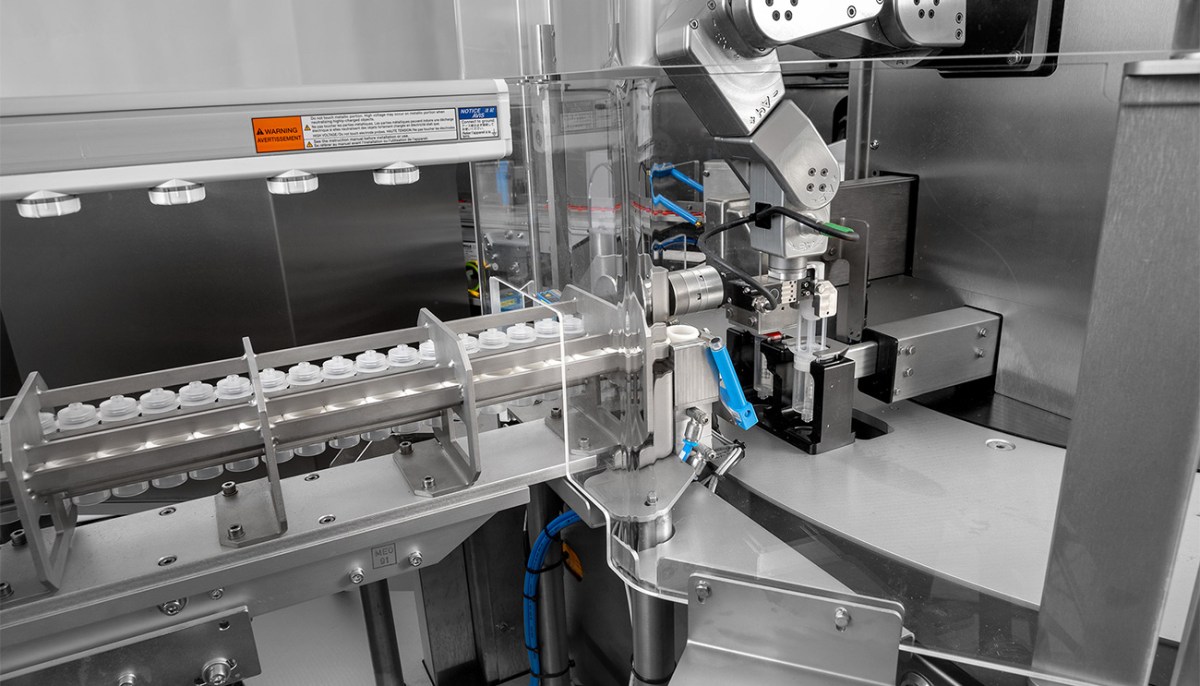
  • The next system requires extreme precision and uses a Meca500 to place the ‘inserter tips ’ in front of two cameras placed at 90° for position feedback and inspection since, at this stage, the inserter tips are not consistently straight or uniformly elevated. The cameras ensure quality control by gauging the exact position of the tip and detecting any significant defects like breakage or bending. The robot retrieves the ‘inserter tip’ from the tray, inspects its position, assembles it with the punctal plug, and deposits it into the crown.
  • Finally, as part of the packaging process, another Meca500 places the inserter tip with the punctal plug onto a preformed tray, and the sealing machine packages the punctal plug in its tray with an aluminum laminate lid for sterilization.

03

Manufacturing benefits of the Meca500 

According to Mati Therapeutics, the company opted for the Meca500 robotic arm for pick-and-place tasks, inspections, and assembly operations over its competitors for several key reasons, including, in order of priority:

Compact size

The Meca500 is the world’s most compact robot, allowing it to be used in applications where space is limited. In manufacturing facilities, space is often at a premium, and having a robot with a small footprint can result in cost savings. A compact robot can be easier to integrate into existing manufacturing processes, saving time and money. A larger robot may require modifications to the manufacturing line, whereas a smaller robot can often be integrated without significant changes. Finally, a compact robot can be more versatile and mobile than a larger robot. It can be used in various applications and moved from one location to another. This flexibility can be especially useful in manufacturing facilities where processes and equipment may need reconfiguring periodically to accommodate changing production needs. Overall, its compact size makes it a valuable tool for manufacturers looking for a precise, flexible, and easily integrated robot solution.

Highest precision in the market

Many medical devices and pharmaceutical products require extremely precise manufacturing processes. The Meca500 robot’s sub-micron accuracy is necessary for assembling small medical devices, handling delicate materials, and performing complex procedures. In Mati Therapeutics’ case, the Meca500 was used for position feedback and inspection, ensuring that the product met the required specifications and was safe for patients. Additionally, the precision of the Meca500 can help reduce waste and improve efficiency, leading to cost savings. Overall, the Meca500’s precision significantly benefits the medical industry, enabling manufacturers to produce high-quality products that meet rigorous standards.

No external controller

The Meca500’s lack of a separate controller offers several benefits, including reduced overall size and complexity, simplified communication and control systems, improved reliability and durability, and increased cost-effectiveness. The robot’s compact size and integrated control system make it easier to integrate into existing manufacturing processes and workspaces. Additionally, the absence of a separate controller reduces the risk of communication errors, cable wear, and damage over time, improving the robot’s overall reliability and durability. Finally, the lack of a separate controller can make the Meca500 more affordable, enabling greater accessibility to small and medium-sized businesses, startups, and research organizations with limited budgets.

EtherCAT communication

The Meca500’s EtherCAT communication protocol is advantageous for several reasons, including its real-time communication capabilities, open standard interoperability, and reliability. EtherCAT allows for precise synchronization and coordination of robotic movements, improving production processes and reducing cycle times. Its open standard allows greater flexibility and interoperability with different automation equipment and control systems. At the same time, its reliability and robustness make it well-suited for precision manufacturing in the medical industry and other applications.

Integrated gripper

By having its own integrated gripper systems, Mati Therapeutics can save time and effort in setting up the manufacturing process, leading to increased productivity and cost savings in the long run. Since Mecademic grippers are integrated into the robot’s programming, there is also less chance of errors or malfunctions that could disrupt the manufacturing process.

Short lead time

Lead time refers to the time between placing an order and receiving the product, and in manufacturing, longer lead times can result in production delays, which can be costly. With the Meca500, Mati Therapeutics can reduce the time it takes to set up their manufacturing process and start producing their product, which helps them get to market faster and stay competitive.

Price

Mecademic robots are extremely affordable compared to their competitors and more cost-effective than traditional robots in specific applications because they require less floor space, have lower energy consumption, and can be integrated more easily into existing production lines. With free firmware updates, no paid software options, and maintenance-free operation, the total cost of ownership is very competitive.

Results 

Switching from using a CMO to running their own manufacturing facility had immense benefits for Mati Therapeutics. Mecademic’s Meca 500 has proven to be a valued component in the company’s successful transition and production process.

Flexibility

Mati Therapeutics now has more control over production and can easily adjust to changes in demand. In fact, with just one production line, they can churn out over a million products in a single shift, and if demand surges, they can quickly respond by simply adding another shift or production line.

Greater output

Thanks to this greater flexibility, Mati Therapeutics now boasts an impressive annual output of tens of millions of units.

Increased Company Value 

By owning their manufacturing facilities and ramping up production, the company has enhanced its appeal as an acquisition target and partner, thereby increasing its overall value.

What’s next for Mati?

Although Mati Therapeutics was forced to take on in-house manufacturing to respond to pandemic delays, what began as a necessity became a game-changer for the company. Only a few years later, Mati is expanding its manufacturing suite to meet the demands of an international market.

“This is an incredibly exciting time to be with Mati Therapeutics,” says Butchofsky. “The products manufactured here in Texas will be going all over the world to treat patients and prevent vision loss. So our dream of doing that is close to becoming a reality.”

Mati Therapeutics turned adversity into an opportunity to fast-track their goals. Through this, they not only demonstrated that getting into manufacturing and automation is attainable for small companies but also highlighted the immense return on investment that doing so can offer.

About Mati Therapeutics

Mati Therapeutics is an ophthalmic pharmaceutical company based out of Texas that is innovating drug-delivery systems for ocular disease. The company developed a unique eye-drop delivery platform called the Evolute system, designed to enhance the delivery and efficacy of drugs in treating eye diseases such as glaucoma and dry eye syndrome.

About the Meca500

The Meca500, designed and manufactured by Canadian robotics company Mecademic, is the world’s smallest and most precise six-axis industrial robot, with a compact size and repeatability of 5 micrometers. It has six degrees of freedom, making it highly flexible and capable of performing complex tasks in various industries, such as medical, lab automation, electronics, and aerospace. The Meca500 is also easy to integrate and program, not requiring any specific programming language, and comes with a user-friendly web interface.

Ready to find out how our products and solutions can increase your production throughput within the smallest possible footprint, without sacrificing precision, or reach?

Want to learn more? 


Chat with our experts to get started on your application.

Categories
Case Studies

Workforce health drives Cretex Medical to automate precision assembly

CRETEX MEDICAL

Workforce health drives Cretex Medical to automate precision assembly

01

Problem

Cretex Medical, an innovative contract manufacturer for the medical device industry, faced a difficult challenge. Responsible for manufacturing a critical component for intravascular lithotripsy (IVL) catheter devices, they needed to find a way to optimize the daily work experience of their assembly team and scale up production at the same time.

“Think of this manual process as the extreme limits of what you can humanly do by manipulating tweezers under a microscope. The size of this assembly is not any bigger than an eyelash, and the ergonomics of this repetitive process were taking a real physical and mental toll on our people,” says Steve Lagergren, Manufacturing Engineering Supervisor, Cretex Medical.

The demand for this component was high, and their customer was counting on them to scale up production. Jeremy Glynn, General Manager of Cretex Medical, Laser Division, adds, “There are patients at the end of the line who depend on these intravascular therapies. We could not allow our assembly to disrupt supply.”

Cretex Medical turned to Arimation Robotics, a machine builder with a track record of solving complex problems, for the answer.

Case Study Video

"Think of this manual process as the extreme limits of what you can humanly do by manipulating tweezers under a microscope. The size of this assembly is not any bigger than an eyelash, and the ergonomics of this repetitive process were taking a real physical and mental toll on our people."

Steve Lagergren,

Manufacturing Engineering Supervisor at Cretex Medical.

02

Solution

Traditional robotic solutions were no match for the tiny component size and complicated 26-step manual process. The solution needed to automate and streamline the process of cutting wire, inserting in sleeves, crimping the parts together and inspecting the final component — all at micron-level resolution.

“The majority of robotic products were too large and not accurate enough. We worked closely with the team at Cretex Medical to define requirements and perform feasibility testing to eliminate risk before building the automation,” says Ari Pitkanen, Chief Executive Officer at Arimation Robotics.

Arimation brought in their value-added distributor, Mechatronic Solutions, to assist in recommending and sourcing the main parts. With their support, Arimation designed, built and tested a custom automation cell with three main elements:

  • A Meca500, the six-axis robotic arm from Mecademic, selected for its small form factor and 5 micrometers repeatability for precision automation
  • An Asycube 50, the flexible feeding system with EYE+ from Asyril, built for tiny components and flexibility with advanced controls for integrators,
  • A custom wire feeding and cutting solution to accurately and consistently manipulate 0.1 mm thick wires.

03

Value

Cretex Medical identified three main areas of value resulting from this automation:

Healthy work environment

Improving the work environment for their operators was the main result. The automation allowed Cretex Medical to shift the existing team to ergonomically healthy positions within the company.

“I worked on this component assembly process for 18 months. We knew our customer depended on our components to ultimately serve patients in need, so we stuck with it while this automation system was being built. Now, I am excited to have a new opportunity to learn how to run this automated cell, as well as learn other products. This micro-assembly process is one where automation was clearly a better option,” shared Terri Harris, a Production Tech at Cretex Medical.

Increased throughput and higher yield

The growing demand for this component required the ability to scale up rapidly and with quality. “We needed a solution that increased our output while ensuring we maintain a consistent, high-quality assembly. Adding new operators was not the answer, but automation was,” says Jeremy.

Reduced assembly line footprint

While the manual process spanned over 12 feet, the automation is just 25% of that size with added benefit of being able to scale up within that same small footprint. “The size of the automated assembly line can fit in a carry-on suitcase. The small form factor matters to help us maximize our clean room space,” adds Steve.

Ready to find out how our products and solutions can increase your production throughput within the smallest possible footprint, without sacrificing precision, or reach?

Want to learn more? 


Chat with our experts to get started on your application.

Categories
Case Studies

Novel Method of Robot-Assisted Additive Manufacturing On-Orbit

NASA

Novel method of robot-assisted additive manufacturing on orbit

Overview

The Meca500 robotic arm from Mecademic is uniquely suited for the aerospace industry. Its small size, lightweight, low energy consumption, and unmatched compactness make it ideal for an aircraft or a spacecraft. In this article, the research authors present a novel method of robot-assisted additive manufacturing on orbit.

The aerospace robotics industry calls for extreme precision to meet strict tolerance requirements, safety standards, and micromanipulation needs. Mecademic’s aerospace clients, ranging from NASA’s Johnson Space Centre to rocket manufacturing industry leaders, benefit from unmatched precision when automating with our Meca500 robot arm. The Meca500 is commonly commissioned to assemble delicate aerospace electronics, perform quality inspections and testing, precision-machine small components, and even micro-manipulate extraterrestrial materials.

With its 5 µm repeatability, the robot guarantees that each task is performed reliably, identically, and at the same rate. Equip the robots with vision systems and sensors for added precision at high work rates.

New robot-assisted additive manufacturing research

The ability to print structures on-demand in outer space has become a necessity for successful space exploration. NASA, SpaceX, Boeing, and others are already printing hundreds of parts and exploring innovative ways of using additive technology.

In this new research paper, the study authors assessed a novel way of printing such functional structures in space, using the Meca500.

They explored two methods for manufacturing large structures using a robotic free-flyer on an air bearing table: Extruding while the free-flyer was moving; and, Splitting the large structure into segments to be printed and assembled.

From the paper, Feasibility Study of Large-Format, Freeform 3D Printing for On-Orbit Additive Manufacturing: “Large scale, on-orbit additive manufacturing (AM) and assembly is being considered as a modular and resource-saving approach to facilitate permanent human presence in space.

To realize this, a novel AM approach to freeform fabricate large, functional structures in space has been developed. Combining the reach of a free-flying CubeSat with a collaborative robotic arm [the Meca500] and a 3D printer, large support-free thermoplastic structures can be manufactured beyond the size of the setup itself.

The continuous printing method could produce consistent results for a single line of material. Using the segmented printing approach, it was possible to print a truss structure with a length of over 700 mm. The dependency of the support-free printing method on the direction of the gravity vector was explored, and it was found through visual inspection that printing in −1 g produced no discernible differences from printing in 1 g. As such, it is posited that the method can be used independently of the gravity direction and in microgravity.

We have thus demonstrated the feasibility of a small spacecraft to manufacture support-free structures larger than itself using a robotic arm with a 3D printhead end effector. Using such a spacecraft would allow support-free 3D printing of structures with unlimited dimensions and offers more flexibility than the truss manufacturing machines proposed by others.”

Ready to find out how our products and solutions can increase your production throughput within the smallest possible footprint, without sacrificing precision, or reach?

Want to learn more? 


Chat with our experts to get started on your application.

Categories
Case Studies

Automating a Solar Cell Research Platform: A Smart Lab for Greener Energy

University of Montreal

Automating a solar sell research platform: a smart lab for greener energy

01

Overview

Today’s chemistry labs are about working smarter, not harder. Higher reproducibility and speed are increasing throughput and research quality. No longer saddled with tedious, repetitive tasks, scientists can finally focus on more creative aspects of their work. This article features Dr. Daniel Chartrand, Ph.D., and the automation platform he built at the University of Montreal (U of M). The platform intends to accelerate the University’s research on solar cells for greener, cleaner energy.

Dr. Chartrand needed to automate the fabrication and characterization of small test solar cells in inert atmosphere enclosures.

Vidéo sur l'étude de cas

Solar cells

Solar cells generate energy when light, or photons, are absorbed by semiconducting materials and converted into electricity. Solar cell devices are the electrical building blocks of solar panels. Commonly used to produce clean energy, they can detect light and measure its intensity.

Solar cell production isn’t always environmentally friendly due to the materials and energy it consumes. That’s why researchers worldwide are seeking better ways to produce them.

Dr. Chartrand’s system provides researchers at the U of M chemistry lab with a fast automation platform to explore new solar cell materials and production methods.

02

Solutions

For the robot component, Dr. Chartrand selected the world’s smallest six-axis robotic arm, the Meca500. Mounting the robot on a linear axis greatly enhanced its reach beyond what would have been possibly gained from using a larger robot. The robot’s minute and reproducible positioning removed the need for an alignment system using vision or other means.

From manual to robotized movements

First, the robot places a rack on its base. Then, it transfers a glass substrate from the base to the spin-coater. Next, a liquid handler prepares and deposits liquids on the glass substrate, followed by a heating plate for annealing (heat treatment). Once a set time is reached, the robot removes the glass substrate from the plate, flips it, and deposits it in a tray, which, once full, is loaded by the robot into a vacuum chamber for metal deposition.

03

Benefits

Thanks to this platform, throughput is increased by a factor of 10. Minute, reproducible movements are possible, and so are variable solution preparations and annealing times. This translates into higher research quality. Above all, Dr. Chartrand’s automation frees researchers from the tedious, repetitive aspects of their work so they can focus on innovating in service of the environment.

About Dr. Chartrand

Dr. Daniel Chartrand holds a Ph.D. in Coordination Chemistry from the University of Montreal, where he has been working for the past fourteen years. He’s currently a Research Advisor at the Department of Chemistry’s Laboratory of Analysis of Materials’ and Molecules’ Photoactivity (LAMP). 

Dr. Chartrand has developed a passion for designing and implementing automations to enhance throughput of analytical techniques, such as this robotized characterization of solar devices.

The University of Montreal

The University de Montreal is one of the world’s leading research universities. Established in 1878, in Montreal, Quebec, the university aims to contribute to societal wellness by placing itself at the forefront of knowledge.  With this goal, the university inaugurated a new state-of-the-art science complex known as the MIL Campus in 2019, for cutting-edge research.

Ready to find out how our products and solutions can increase your production throughput within the smallest possible footprint, without sacrificing precision, or reach?

Want to learn more? 


Chat with our experts to get started on your application.

Categories
Case Studies

GTE Innovates with LAP-C Carton Folding Machine

GTE

GTE innovates with LAP-C carton folding machine

01

Overview

The LAP-C carton folding machine by GTE-engineering is a fully automated packaging system with a small footprint. The project, led by Mark van den Munckhof, was developed for a GTE customer in the medical industry.

Cleanroom requirement:

To fit a cleanroom, GTE used their Lean Automation Platform circular (LAP-C) alongside Mecademic’s Meca500 robotic arm. This guaranteed a small footprint — an essential requirement as their customer intends to use the machine in a cleanroom.

On why GTE chose Mecademic’s robotic arm:

The Mecademic robot offers a unique solution to precision positioning and manipulation in tight spaces, an intelligent alternative to fixed automation. The small robotic arms are easily integrated into a final product. It can be installed on a production line or used as a desktop tool. It enables a whole new range of processes, products and opportunities previously impossible. It’s, until now, the smallest, most compact and precise 6-axis industrial robot we have found.

Case Study Video

LAP-C folding machine

The folding machine comprises six stations that automatically separate flat boxes, apply glue, and then fold them. Briefly: The first four stations fold and glue each box using a hot melt adhesive. At the fifth station, an insert is folded and placed into each box. At the sixth and final station, each box is closed and automatically discharged onto a packing table.

02

Product Highlights

  • Small footprint
  • Can process two box sizes with five different inlays
  • Built with quickly interchangeable parts that can be replaced without the need for tools
  • Small footprint
  • Typical cycle times range from 3-10 seconds
  • Can be used for assembling, packaging, or processing
  • The world’s smallest, most compact six-axis robotic arm
  • Boasts a repeatability of 5 μm
  • Device and programming language agnostic

Ready to find out how our products and solutions can increase your production throughput within the smallest possible footprint, without sacrificing precision, or reach?

Want to learn more? 


Chat with our experts to get started on your application.

Categories
Case Studies

Meca500 Increases Production for Token’s Smart Ring Assembly

TOKEN

Meca500 increases production for Token's smart ring assembly

01

Overview

Token, a manufacturer of innovative smart rings for payments and building access, integrated Meca500 robot arms into their product assembly cells. They required a solution with a small footprint to improve precision and lower manufacturing costs. Using Meca500 robots gave Token more flexibility in their assembly system design, increased throughput, reduced tolerances, and improved automation ROI.

Token smart ring used with Meca500 robots for enhanced automation and precision in industrial applications.

Challenge

Token needed a highly precise, compact, and cost-effective solution to automate the assembly of their Token smart rings. Their goal was to minimize the automation footprint in order to make the most of the space within assembly cells and keep manufacturing costs low. Precision was a priority. To continue pushing the size constraints of their product’s small design, Token was looking for a robot that could work with tiny components and keep tolerances to an absolute minimum. Before integrating Meca500 robots, assembly was performed by hand. This process was time-consuming with limited throughput. Other robotic solutions were explored, but they didn’t meet precision requirements and were deemed cost-prohibitive.

02

Solution

Token commissioned several Meca500 robot arms to assemble the electronic components of the rings, performing micromanipulation, dispensing, and welding tasks. The robots are integrated into small assembly cells, where they maneuver product components around various stations and collaborate with equipment for adhesive dispensing and welding. Each Meca500 robot works with a variety of circuit components as well as small metal and plastic enclosure parts. The robots are integrated with Omron PLCs and HMIs.

03

Results

Design flexibility

With their six degrees of freedom and ability to be mounted in any orientation, the Meca500 robots could easily access all the space within the assembly cell from various positions. This gave Token’s team more flexibility in assembly process development, making it easy to adapt to product or process changes. Such flexibility reduced time to market and prevented additional costs that would have been allocated to redesigning the assembly system.

More productivity with a small footprint

Due to the robot’s small size and footprint, Token was able to create compact yet efficient assembly systems using only two robots per cell. These two robots perform eleven assembly steps using a total machine footprint of only 20 square feet. This small footprint and maximum throughput design reduced manufacturing costs.

Reduced tolerances in product assembly

Some sequences in the Token ring assembly process required handling tiny, delicate parts with extreme precision. The Meca500 robots performed these sequences with 5 micrometers of repeatability, producing consistent results at higher speeds.

04

About Token

Token, a NY-based manufacturer, created smart rings that allow users to store all their credentials in one secure place. The ring is designed to replace access badges, payment cards, and other future applications without relying on a smartphone. With continuous 2-factor authentication (2FA) across all digital interactions, users can make contactless payments and access buildings faster and easier with always-on security. The ring features integrated fingerprint and proximity sensors, ensuring that Token only works on its owner’s finger and no one else. With Token, users can prove and protect their identity with security wrapped around their fingers. To learn more about Token, visit their website. The images in this post are courtesy of Token.

Ready to find out how our products and solutions can increase your production throughput within the smallest possible footprint, without sacrificing precision, or reach?

Want to learn more? 


Chat with our experts to get started on your application.

Categories
Case Studies

Smart Micro Factory Revolutionizing Watchmaking with Meca500 Robot

HOROSYS

Smart Micro Factory revolutionizes watchmaking with the Meca500 robot

01

Overview

When Horosys, a Swiss integrator specializing in desktop automation for watchmaking, saw the ultra-compact, highly precise Meca500 robot, the idea for the Smart Micro Factory (SMF) project was born. Horosys developed the SMF concept to fulfill the automation needs of the Swiss watchmaking industry and make automation and robotics available to manufacturers producing in low volumes, with limited investments, and requiring a quick payback.

The modular desktop factory can assemble, rivet, and push fit jewels and multiple watchmaking components. With its tiny footprint, embedded controller, and open programming environment, the Meca500 is an integral part of the solution. Horosys was able to standardize, add flexibility, and optimize the cost of the Smart Micro Factory using the world’s smallest and most precise industrial robot.

Case Study Video

Challenge

Traditionally a labor-intensive industry, the lack of skilled workers and precision requirements of the watchmaking space push Swiss manufacturers to automate. However, most industrial robots are too large and bulky to handle parts weighing just a few grams. Collaborative robots and other small non-industrial robots lack the needed high precision to handle such delicate and precise parts. Furthermore, the systems must be small enough to fit on existing workshop benches. Although custom linear XYZ stages can be considered in some applications, many require at least 5 or 6 degrees of freedom, so an articulated robot arm is necessary. The systems also need to be modular, easily programmable, and able to integrate and communicate with many other types of equipment.​

02

Solution

To meet those needs, Horosys developed the Smart Micro Factory concept around the Meca500. The modules (also called stations) can be equipped with different Cognex cameras, bowl feeders, flexible feeders, presses, and other standard and custom metrology equipment. The modules can be combined for various processes to form an entire production line.

A B&R Automation IPC or a Beckhoff IPC controls the SMF. The Meca500 is controlled directly by the B&R IPC through the TCP/IP protocol or by the Beckhoff directly with the EtherCAT protocol and a standard set of commands. The user also has control access and troubleshoots the system and the robot remotely through a web server.

Take a look at this video Gimmel Rouages, a supplier of miniature components for some of the most renowned luxury watchmakers, featuring one of Horosys’ SMFs.

03

Results

Increased Product Quality

The Meca500’s unmatched precision of 0.005 mm guarantees that the whole process can meet the tight requirement 0.01 mm of positional repeatability for many processes in watchmaking.

Save Space

The modules typically measure 600 mm x 600 mm only. This desktop solution is only possible because of the embedded controller and the tiny size of the Meca500. Although there exist a couple of other robots comparable in size, these robots are bulkier and, most importantly, have large external controllers, teach pendants, and cumbersome cables.

Save Power

Since the Meca500 consumes less than 30 W of power on average, the SMF solution is very energy-efficient, consuming less than 80 W in many configurations. Similar solutions with linear motors can easily take 1-2 kW.

Save Costs (Standardize and Add Flexibility)

A 6-axis robot is significantly more flexible than custom 3-axis XYZ systems. This means that it could work with a much greater variety of components and equipment. Therefore the systems become modular and have much greater flexibility, reducing overall costs.

04

About Horosys

Horosys is a Swiss integrator based in the Canton of Neuchâtel, the heart of the Swiss “Watch Valley” and home to some of the most famous watchmakers: Breitling, Patek Philippe, Rolex, Tissot, and others. Horosys develops ultra-compact, automated workstations for the watchmaking industry. Horosys partnered with Mecademic from the very beginning, seeing the Meca500 miniature robot as the perfect fit for desktop factory automation. The company even developed a high-end protection cover for the Meca500, called the HoroBot.

The images and video in this post are courtesy of Horosys SA.

Ready to find out how our products and solutions can increase your production throughput within the smallest possible footprint, without sacrificing precision, or reach?

Want to learn more? 


Chat with our experts to get started on your application.