
MATI THERAPEUTICS


The Meca500 is the world’s most compact robot, allowing it to be used in applications where space is limited. In manufacturing facilities, space is often at a premium, and having a robot with a small footprint can result in cost savings. A compact robot can be easier to integrate into existing manufacturing processes, saving time and money. A larger robot may require modifications to the manufacturing line, whereas a smaller robot can often be integrated without significant changes. Finally, a compact robot can be more versatile and mobile than a larger robot. It can be used in various applications and moved from one location to another. This flexibility can be especially useful in manufacturing facilities where processes and equipment may need reconfiguring periodically to accommodate changing production needs. Overall, its compact size makes it a valuable tool for manufacturers looking for a precise, flexible, and easily integrated robot solution.

Many medical devices and pharmaceutical products require extremely precise manufacturing processes. The Meca500 robot’s sub-micron accuracy is necessary for assembling small medical devices, handling delicate materials, and performing complex procedures. In Mati Therapeutics’ case, the Meca500 was used for position feedback and inspection, ensuring that the product met the required specifications and was safe for patients. Additionally, the precision of the Meca500 can help reduce waste and improve efficiency, leading to cost savings. Overall, the Meca500’s precision significantly benefits the medical industry, enabling manufacturers to produce high-quality products that meet rigorous standards.
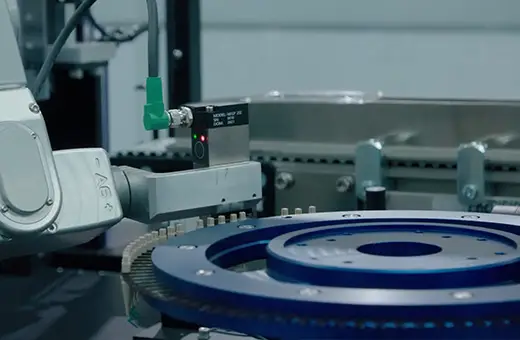
The Meca500’s lack of a separate controller offers several benefits, including reduced overall size and complexity, simplified communication and control systems, improved reliability and durability, and increased cost-effectiveness. The robot’s compact size and integrated control system make it easier to integrate into existing manufacturing processes and workspaces. Additionally, the absence of a separate controller reduces the risk of communication errors, cable wear, and damage over time, improving the robot’s overall reliability and durability. Finally, the lack of a separate controller can make the Meca500 more affordable, enabling greater accessibility to small and medium-sized businesses, startups, and research organizations with limited budgets.
The Meca500’s EtherCAT communication protocol is advantageous for several reasons, including its real-time communication capabilities, open standard interoperability, and reliability. EtherCAT allows for precise synchronization and coordination of robotic movements, improving production processes and reducing cycle times. Its open standard allows greater flexibility and interoperability with different automation equipment and control systems. At the same time, its reliability and robustness make it well-suited for precision manufacturing in the medical industry and other applications.
By having its own integrated gripper systems, Mati Therapeutics can save time and effort in setting up the manufacturing process, leading to increased productivity and cost savings in the long run. Since Mecademic grippers are integrated into the robot’s programming, there is also less chance of errors or malfunctions that could disrupt the manufacturing process.
Lead time refers to the time between placing an order and receiving the product, and in manufacturing, longer lead times can result in production delays, which can be costly. With the Meca500, Mati Therapeutics can reduce the time it takes to set up their manufacturing process and start producing their product, which helps them get to market faster and stay competitive.
Mecademic robots are extremely affordable compared to their competitors and more cost-effective than traditional robots in specific applications because they require less floor space, have lower energy consumption, and can be integrated more easily into existing production lines. With free firmware updates, no paid software options, and maintenance-free operation, the total cost of ownership is very competitive.
Switching from using a CMO to running their own manufacturing facility had immense benefits for Mati Therapeutics. Mecademic’s Meca 500 has proven to be a valued component in the company’s successful transition and production process.
Mati Therapeutics now has more control over production and can easily adjust to changes in demand. In fact, with just one production line, they can churn out over a million products in a single shift, and if demand surges, they can quickly respond by simply adding another shift or production line.
Thanks to this greater flexibility, Mati Therapeutics now boasts an impressive annual output of tens of millions of units.
By owning their manufacturing facilities and ramping up production, the company has enhanced its appeal as an acquisition target and partner, thereby increasing its overall value.
Although Mati Therapeutics was forced to take on in-house manufacturing to respond to pandemic delays, what began as a necessity became a game-changer for the company. Only a few years later, Mati is expanding its manufacturing suite to meet the demands of an international market.
“This is an incredibly exciting time to be with Mati Therapeutics,” says Butchofsky. “The products manufactured here in Texas will be going all over the world to treat patients and prevent vision loss. So our dream of doing that is close to becoming a reality.”
Mati Therapeutics turned adversity into an opportunity to fast-track their goals. Through this, they not only demonstrated that getting into manufacturing and automation is attainable for small companies but also highlighted the immense return on investment that doing so can offer.
About Mati Therapeutics
Mati Therapeutics is an ophthalmic pharmaceutical company based out of Texas that is innovating drug-delivery systems for ocular disease. The company developed a unique eye-drop delivery platform called the Evolute system, designed to enhance the delivery and efficacy of drugs in treating eye diseases such as glaucoma and dry eye syndrome.
About the Meca500
The Meca500, designed and manufactured by Canadian robotics company Mecademic, is the world’s smallest and most precise six-axis industrial robot, with a compact size and repeatability of 5 micrometers. It has six degrees of freedom, making it highly flexible and capable of performing complex tasks in various industries, such as medical, lab automation, electronics, and aerospace. The Meca500 is also easy to integrate and program, not requiring any specific programming language, and comes with a user-friendly web interface.
Subscribe now to keep reading and get access to the full archive.
