
XVP pHOTONICS
XVP Photonics develops advanced photonic products and the assembly processes needed for their manufacturing, serving as a trusted innovation partner for its clients. By offering these capabilities as a service, XVP helps businesses—from small startups to leading tier-one companies—streamline development and bring products to market faster and more reliably.
With a proven track record of success and a customer base spanning the US, Canada, Europe, and Asia, XVP supports various industries, including aerospace, MedTech, telecom, automotive, LiDAR, quantum sensors, and quantum computing. Their expertise accelerates innovation across all areas of photonics, helping customers shorten their time to market while achieving reliable manufacturing processes and meeting rigorous industry standards.


At XVP Photonics, developing advanced photonic products begins with understanding customer needs to deliver tailored technical solutions, starting with proof-of-concept demonstrations and functional prototypes. This is followed by developing manufacturing processes and equipment to achieve a scalable, reliable, and manufacturable product. In that aspect, one of XVP’s challenges is the inherent high cost and complexity of automating product assembly, given the ultra-high precision required in optics and photonics.
Photonic systems typically demand highly precise positioning, obtained using specialized motion actuators like high-precision linear motor stages and Piezo-actuated flexure positioners. While highly accurate, these tools are expensive and have a restricted range of motion and little flexibility due to their movement limitations.
XVP’s customers can’t always justify the high cost of a fully automated assembly system in the context of a new product introduction. Starting production with semi-automated, operator-assisted processes is far more common—at least until the product’s commercial viability has been demonstrated in the field, which can hinder market penetration.
This gradual approach to photonics automation was challenged when XVP was introduced to the Meca500, Mecademic’s six-axis industrial robot. At a similar price to a three-axis ball-screw linear positioner (only one of the many elements comprising a typical optical assembly system), the Meca500 seemed precise, flexible, and cost-effective enough to bridge to a fully automated photonics assembly and achieve a seamless transition from low-rate initial production to full-scale automated assembly.
However, six-axis robots were not seen as precise enough for optics and photonics tasks, which made XVP weary of using Mecademic’s robot. “When we started discussing using the Meca500 to replace optical positioners, I was skeptical,” says François Séguin, XVP’s President and Founder. “I had been doing that for 40 years, so it was a sort of knee-jerk reaction to go to traditional photonics positioners.”
Determined to validate the Meca500’s potential, XVP embarked on a rigorous series of tests. The team employed optical methods to evaluate the robot’s performance, starting with transverse accuracy tests using a high-power microscope and angular resolution assessments using a Fourier bench. The results were then compared against theoretical calculations to determine the range of photonics applications the Meca500 could effectively support.
In those tests, the Meca500 delivered the precision needed for critical applications like TO-laser diode collimation and objective lens focusing onto CMOS sensors. The Meca500 shined when aligning pre-collimated fiber assemblies, owing to its impressive angular precision. These measurements and simulations confirmed that the Meca500 could be used for photonics alignment in optical systems with focal lengths above 0.5 mm and mode sizes larger than 5 µm.
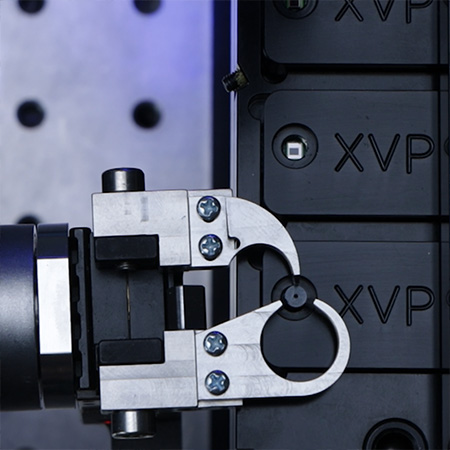
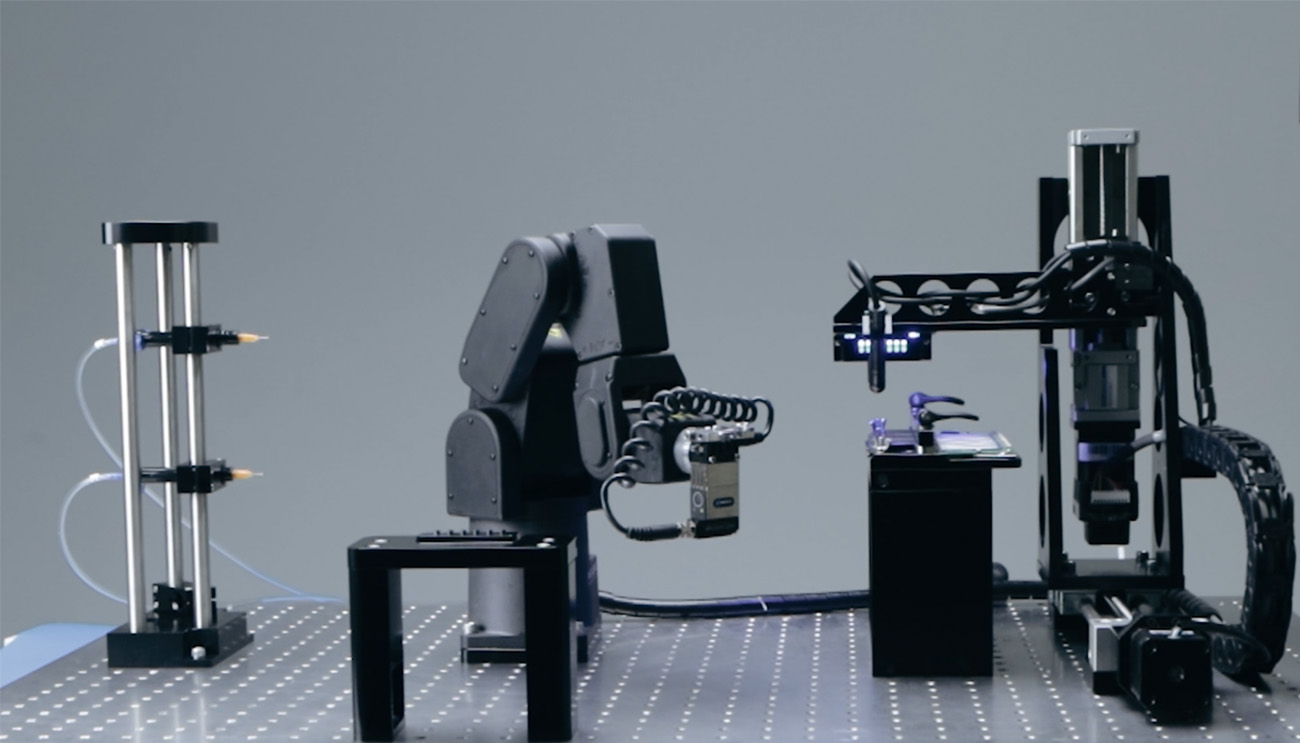
These are the main steps in the optical application built by XVP with the Meca500:
One key difference to the traditional systems developed by XVP Photonics is the number of degrees of freedom required to integrate all movements needed for process automation. With the Meca500, a single robot can perform all those movements from a fixed station, simplifying system design. Moreover, with its small size, the Meca500 saves space and is flexible enough to be mounted in various positions over the assembly area.
Sébastien Allen, XVP’s Process Development Director, also praises the Meca500’s ease of use and plug-and-work capabilities, enabling quick integration. The robot’s primary benefit to him, however, is the repeatability. “By removing the human factor when you apply the glue or align the lens, you have optimization. You don’t have to realign it. Everything is where I should be.”
After testing the Meca500 and building the application, Séguin concludes that XVP can use the robot for about 90% of its current projects. With its compactness and six degrees of freedom, the Meca500 can create automated assembly stations with full versatility from the start, eliminating the cost and complexity barrier of traditional optical positioners. Its versatility also promises to reduce the mechanical layout variability between different applications and produce highly repeatable assemblies in an autonomous process from initial low-rate production.
“You can consider building a platform that is so versatile that all our customers’ projects can be integrated using the same system,” says Séguin. “The same actuator, the same robot, performing tasks that might vary from customer to customer, but from a mechanical standpoint, it can all be done with the same robot.” Excited about this prospect, XVP also documented its findings in a collaborative white paper with Mecademic.
“There can be a paradigm shift in the photonics industry from relying on those traditional positioners to adopting an articulated robot,” concludes Séguin. “I don’t think people in the field of photonics yet realize that.”


Need help automating your optics and photonics processes? Want to learn more about our robots?
Get in touch with our experts today.
