Warning: Read this before purchasing an industrial robot
When it comes to investing in a robot for your business, it’s important to carefully consider all the costs involved, also known as the “Total Cost of Ownership” or TCO, to ensure that you’re getting the greatest Return on Investment (ROI). The base or advertised price of a robot is usually the starting price, and there are many more expenses to consider. The long-term operational costs are significant, and you need to be aware of all these added costs and their requirements before comparing and purchasing your robots. Here, we’ll explore the various factors that can impact the cost of a robot, including direct and indirect costs, and why compared to other Industrial robots, the initial price of the Meca500 is much closer to the overall TCO. The Meca500 is, therefore, the best option for maximizing your ROI and ensuring you meet budgetary needs now and in the future.
Overview
The costs associated with acquiring and using a robot can be classified into two categories: direct and indirect.
- Direct costs are upfront costs when procuring a unit. They tend to be fixed for the most part.
- Indirect costs are those incurred during implementation, operation, and maintenance. In some cases, these costs are recurring.
Some of the components of direct costs are
- The robot’s base price
- Optional add-ons (software and/or hardware options)
- Peripherals (EOATs, vision, safety…)
- Extended warranty
- Training
- Support packages (basic and/or premium)
- Logistics (lead times, shipping and installation)
Components of indirect costs
- Engineering costs for system setup (development and commissioning)
- Maintenance (consumables and spares)
- Downtime costs
- Operation costs (power consumption, machine footprint)
- Upgrade costs
Direct Costs
Base Price
This is the first thing buyers consider. Although the price of many industrial robots has decreased over the last decade, robot manufacturers still charge immense amounts for spares, services, and consumables, so the research should not stop here.
Collaborative robots tend to have a higher base price because they incorporate additional safety and sensing technologies into their standard package.
Factors that impact the base price include the performance envelope (repeatability, speed), reach, and payload capacity. It’s important to understand the application requirements upfront to decide on robot options instead of solely relying on a model’s advertised price.

The Meca500 offers unparalleled precision of 5um in a compact footprint and a competitive base price that includes the controller, cables, and most features as standard. In the next few sections, we will explore how it compares to the market standard.
Optional features and add-ons
Optional features and add-ons can add significantly to acquisition costs.
Specific hardware options include Mounting, cleanroom, IP rating, Communication interface, and software options, such as software libraries. Simulation and offline programming software are often offered so that the system can be tailored to your requirements, and you do not get charged for what you may not need. As an end user, you need to consider the costs associated with any options you need right now and those you might need in the future. We all want to maximize value and ROI, but how?
Some of the main options and their pricing structures are listed below.
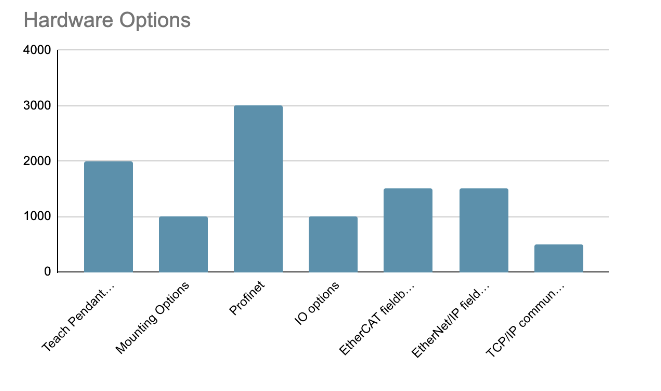
Now let’s compare these optional costs with the Meca500:
| Teach Pendant Options | $0 | With an embedded web interface, the Meca500 eliminates the need for a Teach Pendant. To get started, you need only a laptop and a browser. |
| Mounting Options | $0 | With a smaller size and relatively light payloads, the Meca500 can be mounted in any orientation without hardware or software changes. This makes it a redeployable asset for customers that answers today’s requirements while being flexible for future redesigns. |
| TCP/IP Communication | $0 | The Meca500 supports TCP/IP natively. |
| EtherCAT Fieldbus Option | $0 | The Meca500 supports EtherCAT natively as a slave. |
| EtherNet/IP Fieldbus Option | $0 | The Meca500 supports EtherNet/IP natively as an adapter. |
| PROFINET Fieldbus Option | $0 | The Meca500 supports PROFINET natively. |
| Cleanroom ISO Options | $0* | The Meca500 is clean by design, with no particle-generating components inside. Depending on the cleanroom ISO requirements, it could be used as is. |
With the Meca500, all software and firmware features are included out-of-the-box, which greatly simplifies its pricing. Apart from physical add-ons like the optional grippers, joystick, and case, everything else is included.
Peripherals
Once you’ve decided on a robot and its related options, the next step is to select the right peripherals. This includes end-of-arm tooling, tool changers, a vision system, a force sensor, etc.
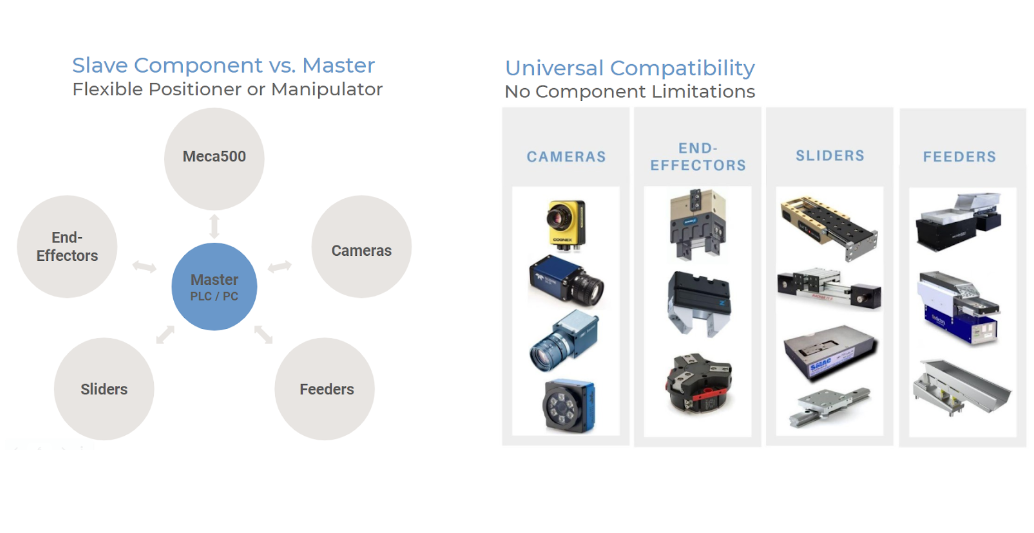
Previously, peripheral options were limited to specific robot brands as a closed ecosystem, but this is changing. While the cost of peripherals is not dictated by the robot vendor, choosing systems that are compatible with the robot to begin with makes a huge difference.
Conversely, the Meca500 offers universal compatibility, as there are no restrictions on peripherals that can be used. That’s because all the components are interfaced via the master that controls the robot.
Training
As with any sophisticated piece of equipment, robot users need specialized training. At a minimum, this would be a one-time investment that adds to capital expenditure.
Most industrial robot manufacturers offer comprehensive training for programming, operation, maintenance, and troubleshooting, which would take about 3 to 5 days. Depending on the scope of a given training, the cost averages US$1500/day. Add to that the cost of related travel expenses, reduced productivity, and project delays.
And while collaborative robots require less training to work with, the time required remains significant. That’s because they typically require learning a proprietary programming language and a custom interface.

Mecademic customers have the option of a two-hour basic training on our robots. Once completed, attendees can understand the basic functionalities of our robot, namely, how to move and program the robot, without any previous programming knowledge.
In addition, we provide a growing library of free start-up guides, online tutorials, and easy programming manuals that remain open and accessible to anyone. Comprehensive online video training is also being developed.
Mecademic’s open programming philosophy means our robots are language agnostic. Our robots can be programmed using C++, C#, LabVIEW, Python, MATLAB, ST, or any other language you prefer! The choice is yours. For instance, do you have an Allen-Bradley PLC programmer who needs to use the Meca500? The robot is controlled directly by the AB PLC, and you can get our free AOIs here: https://support.mecademic.c
om/support/solutions/articles/64000260368-meca500-allen-bradley-compactlogix-plc-add-on-instructions
Are your engineers more familiar with Beckhoff and EtherCAT?
Find an example here: https://support.mecademic.com/support/solutions/articles/64000252476-meca500-beckhoff-twincat3-integration
Other controller examples are available here, for free: https://support.mecademic.com/support/solutions/folders/64000233067
Extended Warranty
Most robots come with a one-year warranty, with the option to buy a one- or two-year extended plan. Warranties typically cost 10-14% of the robot’s purchase price.
As for the Meca500, an additional one-year extended warranty is competitively priced at just 6% of the robot’s cost.

Support Packages (Basic and/or Premium)
This varies significantly from one company to another. Make sure that your robot includes at least a few hours of support in case your engineers or programmers require quick assistance.
Sometimes, you need to buy support hours from the manufacturer or integrator prior to calling. Support package options can have different tiers, each offering varying Service Level Agreements (SLAs). Basic support for the Meca500 is included with the robot’s purchase price.
Logistics (Lead times, shipping and installation)
Shipping most industrial robots costs thousands of dollars. They come on pallets and often require forklifts and a team of skilled professionals to handle the crates and packages safely. Even comparatively smaller industrial robots ship with big controllers, teach pendants and bulky cables in large packages. This is also something to consider if you ever need to move robots between factories. The cost of moving several robots between facilities can be prohibitive for larger industrial robots. These involve costs associated with shipping and handling, as robots are usually packaged in crates.
Due to its tiny footprint and embedded controller, the Meca500 ships in a small box. With insurance, the robot can be shipped for a couple of hundred dollars worldwide. Shipping is also extremely quick, overnight in the US and Canada, 2 days to Europe, and under a week everywhere else. The impact of lead times on planning can be significant. Having engineers, programmers and subcontractors on standby because of long or delayed lead times can be very expensive. Many industrial robot lead times are calculated in months. Because most components are made in-house, the Meca500 has had an average lead time of under 2 weeks over the previous years.

Indirect costs
Engineering costs for system setup (development and commissioning)
Calculating the engineering costs for a project, irrespective of the scope, is always tough as it involves multiple variables, some of which are beyond your control. However, it is important to understand the implications of this cost as it could make or break a project. Choosing the right components and systems saves a lot of trouble and engineering costs. There is no need to reinvent the wheel. Having a robot that is easy to integrate and offers flexibility in implementation can ease the burden on the engineering resources and reduce the need to redesign or redevelop modules for the application.
Operation Costs
Maintenance (consumables and spares)
This is very important with most industrial robots. A preventative maintenance schedule is provided as standard. This indicates when you should tighten or replace the belts, how often to change (often proprietary) batteries and when to change the lubricants. In addition to these consumables, customers are advised to maintain an inventory of critical spares as the lead times for spares can be fairly long. This becomes all the more important for downtime-critical applications. Apart from costs associated with the parts themselves and paying certified or trained technicians to perform the work, you need to consider the downtime required to perform these operations. Over the robot’s lifetime, this could easily cost thousands of dollars. The Meca500 has no belts or batteries, and the oil is sealed inside the harmonic drives. Rated for 50000 hours MTBF, the Meca500 was designed for maintenance-free operation over its lifetime.
Downtime costs
Calculating downtime costs is very important when purchasing a robot. In a manufacturing environment that runs at full capacity, like in the automotive industry, for instance, an hour of downtime when the robot is not operational can easily cost the manufacturer more than the price of the robot itself.
Every Operations Manager will have their operational KPIs like Unit Cost, Units per Hour (UPH) etc., With this, they can roughly calculate the loss of revenue from these downtimes
Production Losses = Unit Cost * UPH * No of Hours of downtime
The above equation is admittedly oversimplified without taking into account other costs for ex:
- Over time expenses that might be incurred during maintenance and production ramp-up post the downtime,
- Engineering hours spent to update the robot program, test and validation before releasing it for production etc.,
The costs so far discussed would make sense for a regular planned downtime. However, with unplanned downtime like a critical failure of the hardware, the cost associated becomes more complex with factors like
- availability of spares,
- lead times for RMA,
- Cost of paying certified technicians from vendors to perform the repair on-site, etc.
Some robot manufacturers and integrators provide accelerated same-day repair services but are also expensive. All of this adds to the overall cost of your robot. The Meca500’s small size and type of programming make it very easy to swap robots. If anything happens to one of our robots, the manufacturer can easily swap it out for another robot in a few minutes. Since the programmed points, in most cases, are stored in the Master controller, swapping the Meca500 is more akin to swapping a linear guide than exchanging a whole robot system. Most of our customers who operate multiple Meca500 lines often have a spare robot in case something goes wrong. Unlike spare parts, this complete robot can be used for training or proof of concepts in other projects while not in production. Because of its small size and simplicity, the Meca500 can often be repaired in under 48 hours in our facility. As mentioned previously, shipping is extremely quick and economical.
Power consumption
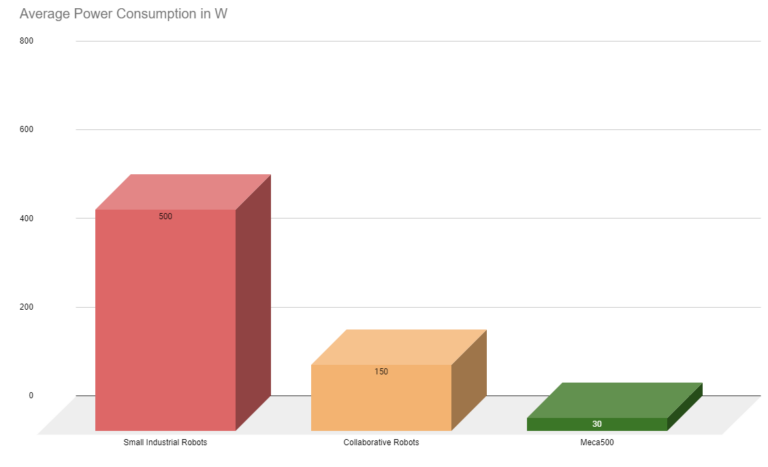
Special power hookups for three-phase power, power consumption in kilowatts and huge battery backups are the norm for most robots, even the smaller industrial ones. When you have tens or hundreds of these robots in your factory, this will have a big impact on your electrical bill. With more and more companies adopting ISO 50001 Energy Management Standards, it’s prudent to plan for systems that comply with these standards. The Meca500 connects to a standard power outlet and consumes under 30W of power on average –not much more than a laptop. You could have a hundred of them in your factory, and they’d consume less than 1 large robot.
Upgrade costs
It is common that newer features and functionalities are made available for robots as the industry evolves, which were not available when you procured the system. It could be as simple as a firmware upgrade. You need to factor in the cost that will be incurred to buy these incremental upgrades. In other cases, these costs could simply be associated with add-on features that you might need to buy for any number of reasons.
Meca500 offers firmware upgrades that add capabilities and features while also fixing bugs with prior versions.
Machine Footprint
Real estate is expensive. If you need to expand your facility to incorporate more robots, this can get very expensive very quickly, especially for applications that demand a specific set of working environments like a cleanroom or BSL facilities, etc. The capital and operational expenses of these spaces cost in the range of tens of thousands to hundreds of thousands of dollars. They cannot be scaled up at a whim. Also, in some densely populated places (like Singapore), even standard industrial space is expensive. This highlights the need to have systems that are optimally using your factory floor and leaving you with options for scalability without a need for a major overhaul.
Industrial robots, even the smaller ones, take up a huge footprint not just for themselves but also for their controllers and other peripherals. For safety reasons, you must create a cordoned environment encompassing the robot’s entire reach envelope. In most applications, this translates to a lot of wasted space. You could consider using some advanced collision detection and avoidance features of the robot to optimize the workspace, but it once again adds to the additional costs of these expensive options. While not being a direct replacement for industrial robots, collaborative robots fare a bit better in this regard with their ability to work alongside humans; however, there still needs to be a safety system in place with proper risk analysis. With its embedded controller, the Meca500 has the smallest footprint of any industrial robot. You can fit a dozen on a standard workbench with no special modifications. The Meca500 is the ideal robot for desktop factories.
Comparison Chart
| Meca500 | Typical Small Industrial Robot | Typical Small Collaborative Robot | |
| Purchase Price | Low | Low (1.2 x Meca500) | High (2 x Meca500) |
| Lead times | Days | Months | Months |
| Shipping | 100-300$ Worldwide | Thousands | Thousands |
| Space Requirement | Smallest Robot | 5 x Meca500 with controller | 5 x Meca500 with controller |
| Power | < 30W | > 500W | >150W |
| Training | Hours | Weeks | Days |
| Features | All Included | Costly Options | Options |
| Maintenance | No Maintenance | Heavy Maintenance | Low Maintenance |
| Downtime | Minutes (with spare) | Hours (with spare parts) | Hours (with spare parts) |
| Support | Included | Paid | Free/Paid |
| Extended Warranty | 6% of purchase price | ??? | 10% of purchase price |
Summary
If you are considering investing in a robot for your business, it’s crucial to take the Total Cost of Ownership (TCO) into account. The initial cost of a robot is just the beginning, as ongoing operational expenses can add up significantly over time. These costs include accessories, engineering costs, maintenance costs, power consumption, and so on. To avoid incurring unnecessary costs for features you don’t need, it’s important to first define your application requirements before purchasing a robot. Depending on your needs, the Meca500 may be the most cost-effective option. Compared to its competitors, the Meca500 is more affordable in every aspect of the TCO. The Meca500’s base price is very competitive already, but compared to competitors, it includes software and firmware, compatibility with peripherals, simple programming, and an extended warranty, meaning its TCO is very close to its base price.