
sdc
The assembly process was originally manual, and it involved handling tiny parts at a microscopic level. Since this work was highly intricate and time-consuming, keeping it done by humans meant less efficiency: with automation, the client hoped to reduce cycle times and improve overall yield.
To solve this problem, SDC resorted to microautomation, building a machine that integrated several components, including Mecademic’s Meca500 supercompact and precise six-axis robot. Learn more about how SDC built this application, how it works, and the results it generated.

The machine SDC developed for their clients required micron-level precision and repeatability to handle the tiny parts involved in the process. For example, the clearance between the rivet and the link hole — the two main elements in the components it builds — is a thousandth millimeter.
To achieve this kind of result, SDC sourced and tested microautomation equipment in phases, ensuring an optimally accurate performance for each automated process prior to the final build.

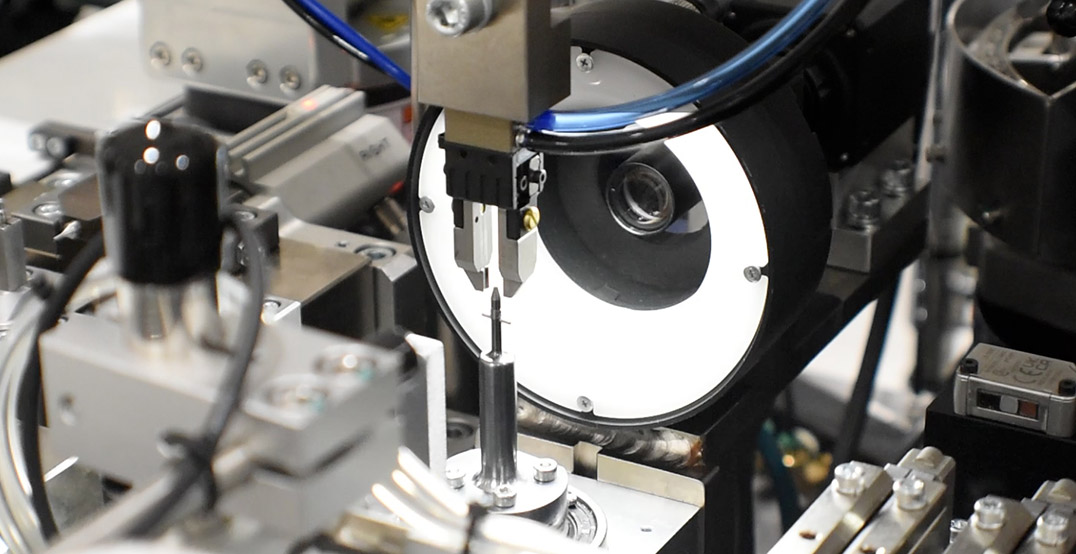
A vibratory feeder bowl from Bellco Feeders supplies four different links to the machine. Then, through vision inspection, the links are accurately oriented for placement on the next stage in the process — the stamping press.
Once the links are correctly oriented, an SMC pneumatic cylinder with a separate set of holding tools drives two adjustable stamping pins into the links’ “ears.” At this step, the links are nested together before a welded rivet joins them in the next stage. If links of different lengths need to be stamped, a Hiwin ballscrew slide can adjust the station and position the links accordingly.
At this stage, a Meca500 six-axis industrial robot by Mecademic inserts the rivets into the links with extremely high precision. Supported by a specialized camera lens and intelligent vision software for a perfect assembly, it reaches between 1μ and 2μ of accuracy and repeatability. One complete assembly comprises 73 parts — 25 links and 48 rivets — and 48 welds.
Welding the part to micron-level precision is crucial: an imprecise weld, even if by just a few microns, will affect the product’s motion and functionality. For that reason, a Keyence camera takes a picture of the part once it’s shuttled under the laser welder. Then, the rivets’ coordinates are sent to the welder — which is attached to another Meca500 so it can weld with a specific shape at an exact location with maximum precision.
At this very last step in the automated assembly process, the part is already finished. Then, the robot removes the finished part from the assembly mandril and loads it on the outfeed conveyor.


