
ZYMERGEN
Zymergen needed accurate and reliable robots to automate laboratory processes which included the transfer of microtiter plates between various life-science instruments. Their goal was to develop a modular automation solution that could easily adapt to frequently changing processes, teams, and laboratory space constraints. The solution had to maximize throughput while remaining versatile, user-friendly, and easy to program.
Prior to integrating the Meca500, Zymergen had integrated life-science instruments using large robots that serviced numerous instruments. However, these robots were unsuitable for a modular application; their large footprint and high cost limited their flexibility, speed, throughput, and scalability.
Zymergen explored several other solutions. These included building robots in-house and working with vendors to design robots using their off-the-shelf parts.

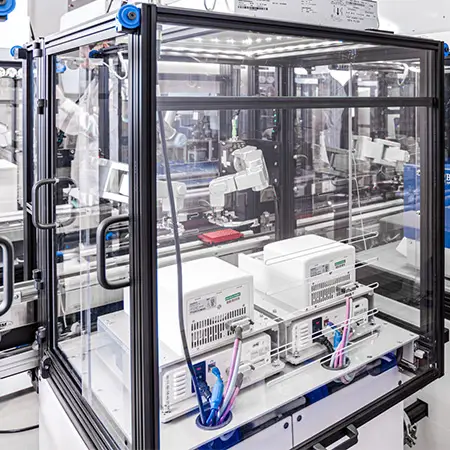
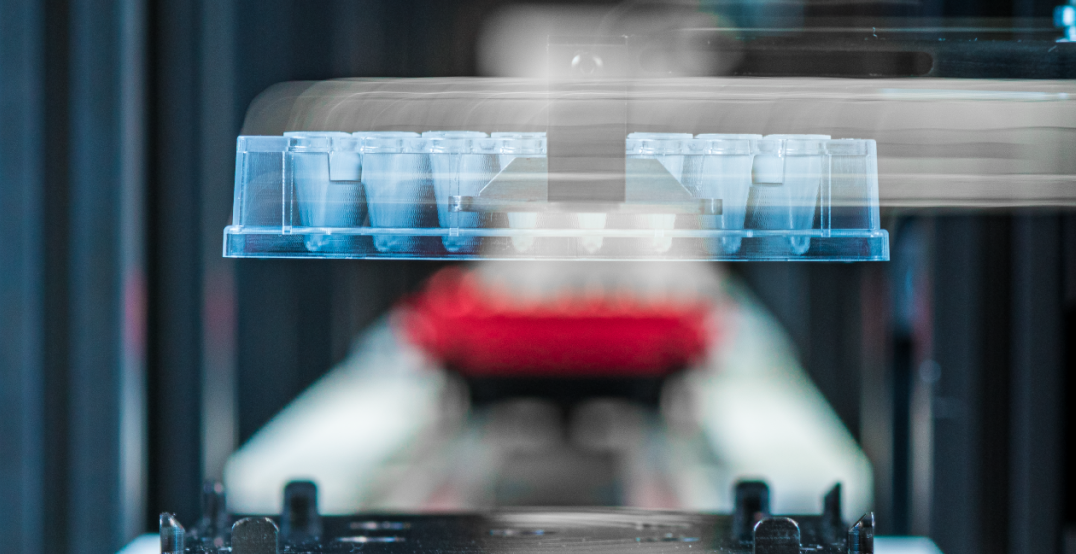
The Meca500 is used to pick and place microtiter plates into life-science instruments. The system is designed to employ one robot per instrument, which enables higher throughput and more reliable system. Aside from building custom grippers with a linear rail guide, no other modifications were needed for the integration.
Working with life-science instruments of various sizes and shapes required high flexibility, which was achieved by mounting the robot in various ways. “One of the things we like about the Meca500 robot is how easy it is to mount it in different orientations…Mounting in any orientation is crucial to being able to use the robot in so many different places,” says Davey. Zymergen’s next step involves employing additional Meca500 robots and mounting some of them on vertical linear guides.
Using the Meca500 shortened integration by nearly eight times compared to other solutions. “We had a very good experience integrating the Meca500 robot. We effectively wrote software to control it in coordination with other life-science instruments within a month or two. By comparison, a lot of the custom robotics solutions required hardware and software efforts that lasted many more months – perhaps six to nine months – to arrive at something that was not nearly as good quality as what we have with the Meca500” says Davey.
Using the Meca500 has enabled Zymergen’s automation engineers and scientists “to think a lot more about both the planning and the data produced rather than managing the nitty-gritty details,” says Peter Kelly, an Automation Scientist at Zymergen. The Meca500 enabled 24/7 maintenance-free operation, removing the need to manage equipment staging, movement between pieces of equipment, and equipment scheduling time.
“The reason we have so many Mecademic arms in this system is because as an end-user, I’m looking for reliability of transfer, consistency of the pick and place, and not needing to think about the arm,” says Kelly. Indeed, the best automation solution is the one you can forget about.
Zymergen is a leader in biofacturing. Building on advances in genomics, machine learning, and lab automation, the company partners with nature to create never-before-imagined materials and products across industries – from agriculture to electronics, consumer care to pharmaceuticals, and more. One of the company’s signatures is its extensive use of flexible automation systems. The Zymergen Automation group has created a custom modular system of Reconfigurable Automation Carts (RACs) relying heavily on our Meca500 industrial robot. To learn more about Zymergen and how they bring revolutionary products to market faster and more sustainably than ever before, visit their website.
Subscribe now to keep reading and get access to the full archive.
